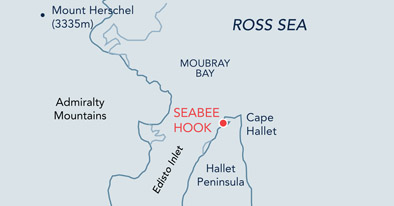
28. Seabee Hook, Cape Hallett |
||||||||||

|
||||||||||
|---|---|---|---|---|---|---|---|---|---|---|
|
||||||||||
|
||||||||||
| Description | ||||||||||
| TOPOGRAPHY | ||||||||||
| Seabee Hook is a large flat cuspate spit composed of coarse material deposited in a series of beach ridges, with gently undulating terrain. It is joined to steep scree forming part of the western slopes of northern Hallett Peninsula. | ||||||||||
| FAUNA | ||||||||||
| Confirmed breeders: Adélie penguin, Snow petrel, South Polar Skua, Wilson’s storm petrel. | ||||||||||
| Regularly haul out: Weddell seal. | ||||||||||
| Also present: Emperor penguin, Leopard seal, Minke Whale, Southern giant petrel. | ||||||||||
| FLORA | ||||||||||
| No significant flora in the visitor areas. | ||||||||||
| HISTORIC HUTS AND ARTIFACTS | ||||||||||
| Site of former NZ/US station that operated from 1956-73, which has been decommissioned and cleaned up. Artifacts from the former station may occasionally be found on shore. | ||||||||||
| OTHER | ||||||||||
| The site is bordered by Antarctic Specially Protected Area No 106, entry to which is strictly prohibited without a permit. | ||||||||||
| Visitor Impact | ||||||||||
| KNOWN IMPACTS | ||||||||||
| At the time of its operation, Hallett Station had a substantial impact on the breeding Adélie penguin colony. Since station decommissioning and clean-up, breeding birds have started to re-occupy the site of the former station. Recovery of the site is an important subject for scientific study. | ||||||||||
| POTENTIAL IMPACTS | ||||||||||
| Disturbance to wildlife, damage to, or removal of, historic artifacts. | ||||||||||
| Landing Requirements | ||||||||||
| SHIPS* | ||||||||||
|
Max pax on board: 200
Ships per day: 1 Comments: * A ship is defined as a vessel which carries more than 12 passengers. |
||||||||||
| AIRCRAFT | ||||||||||
| Overflight and landings within ½ nautical mile (~930m) of the Adélie penguin colony on Seabee Hook for tourism is strongly discouraged. | ||||||||||
| VISITORS | ||||||||||
|
Maximum number of visitors at any time, exclusive of expedition guides and leaders: 100 Visitors per guide: 20 |
||||||||||
| Visitor Area | ||||||||||
| LANDING AREA | ||||||||||
|
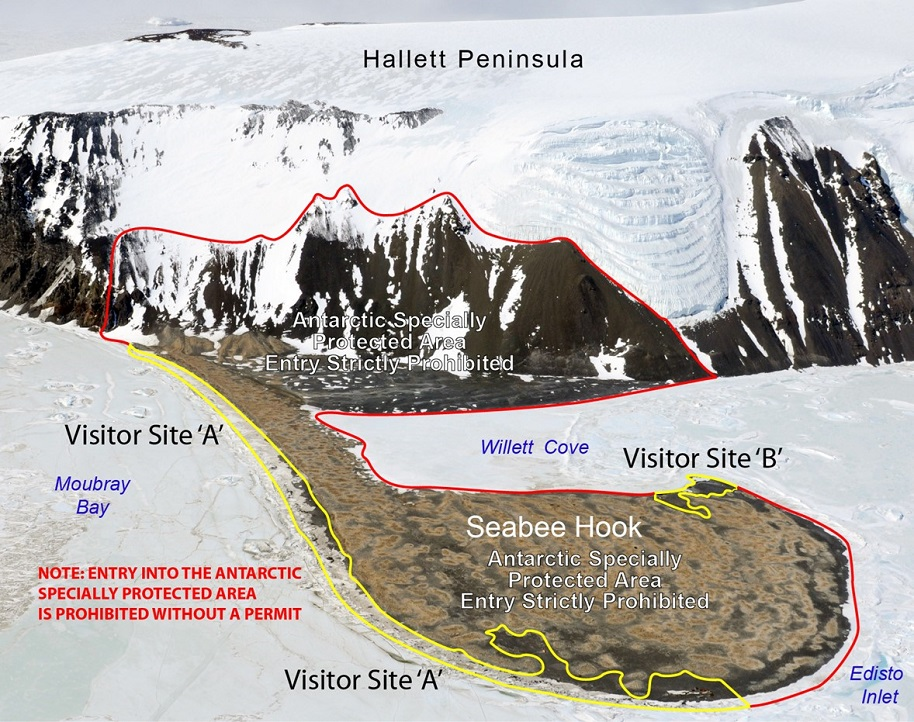
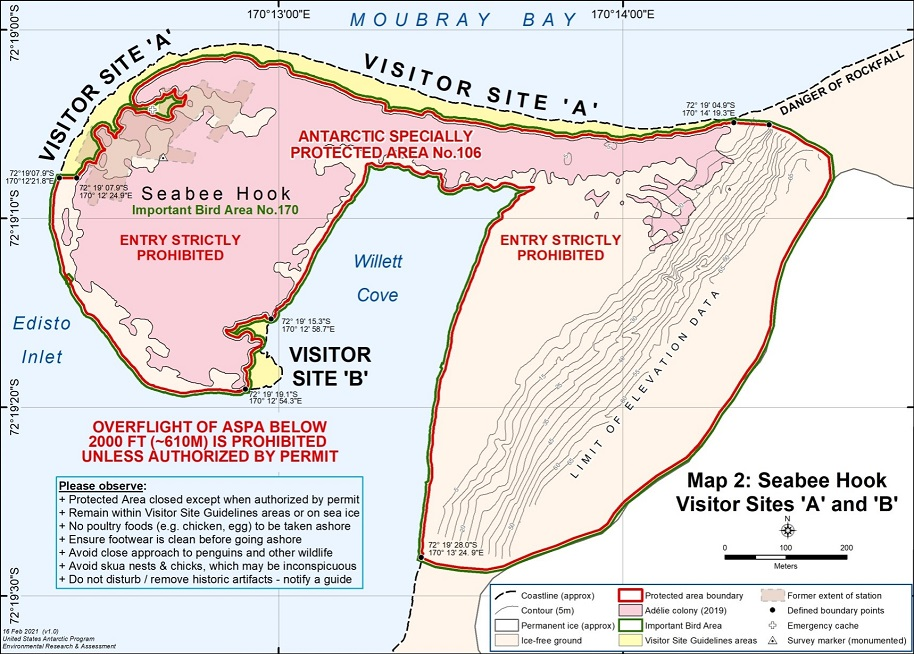
Visitor access is restricted to two defined Visitor Sites located on the northern / NW and SE coasts of Seabee Hook (see Figure 1 and Map 2). Visitor Site ‘A’ is located on the northern / NW coast of Seabee Hook between 72° 19’ 04.9”S, 170° 14’ 19.3”E and 72° 19’ 07.9”S, 170° 12’ 21.8”E. Visitor Site ‘B’ is located on the SE coast of Seabee Hook between 72° 19’ 19.1”S, 170° 12’ 54.3”E and 72° 19’ 15.3”S, 170° 12’ 58.7”E. The preferred landing sites are those in Visitor Sites ‘A’ & ‘B’, but if conditions make these sites dangerous, an alternate landing site along the shoreline between these two sites may be used. This alternative should only be used for safety reasons and following the restrictions noted under Guided Walking Areas. |
||||||||||
| CLOSED AREA | ||||||||||
| Entry into the protected area is strictly prohibited without a permit. | ||||||||||
| GUIDED WALKING AREA | ||||||||||
| When sea ice is absent or unsafe, small, closely guided groups may walk along the shoreline boundary of the protected area between the two visitor sites. These walking groups must be strictly controlled and maintain a ratio of 1 guide to 10 passengers. | ||||||||||
| FREE ROAMING AREA | ||||||||||
| Visitors may roam freely within the defined Visitor Sites (Figure 1 and Map 2). | ||||||||||
| Visitor code of conduct | ||||||||||
| BEHAVIOUR ASHORE | ||||||||||
|
||||||||||
| CAUTIONARY NOTES | ||||||||||
|
Strong tidal currents are known to exist in Edisto Inlet. Pack and brash ice frequently accumulate on the beaches. |
||||||||||

|
||||||||||
|
||||||||||
|
||||||||||
|
Please note that ATCM / CEP circulars are available only to specific contact points.
Please contact your Party Contact Administrator, to confirm if you have privileges to access this section.
To access this section you must log in using your personal Username/Email and password as registered in the AT Contacts Database.
To access this section you must log in using your personal Username/Email and password as registered in the AT Contacts Database.
If you are not registered, please request your party’s Contact Administrator to assign your credentials or contact the Secretariat for assistance.